Niagara Falls Short-Term Rental Rules & Regulations (2026): A Guide for Airbnb Hosts

Niagara Falls, Ontario, has one of the strictest short-term rental frameworks. Currently, the city relies on a licensing system to ensure that the more than 1,100 active Airbnb listings operating are not overwhelming the city streets. The City of Niagara Falls is open for business in a way foreign to nearby cities. To legally operate in Niagara Falls, you need either a Vacation Rental Unit (VRU) licence or an Owner-Occupied Short-Term Rental (OOSTR) licence. Your house is eligible for a licence depending on zoning. The tax applies at 4% of the room rate. A three-strike enforcement system allows for a repeal of a licence for repeat violations. That means investment-property hosting is on the table in most nearby cities that block it outright. This guide by Stayfinity, a trusted provider of Airbnb property management in Niagara Falls, discusses the Niagara Falls short-term rental rules, licence types, zoning, documentation, taxes, and penalties in place in Niagara Falls.
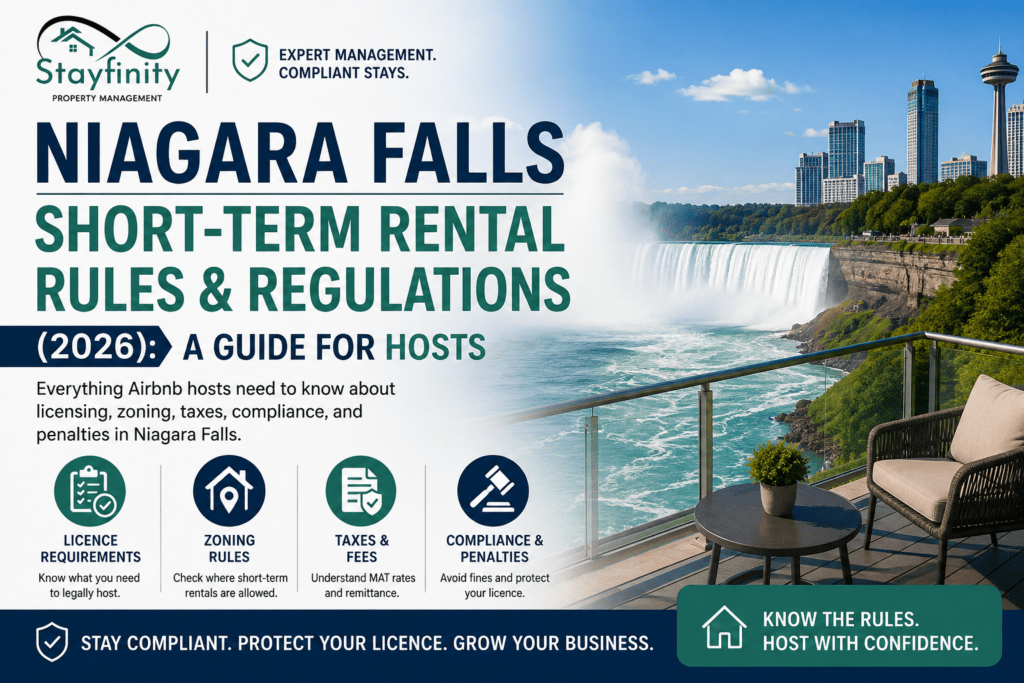
Niagara Falls Short-Term Rental Rules & Regulations (2026) A Guide for Airbnb Hosts

Two Licence Types: VRU vs. OOSTR

Every short-term rental in Niagara Falls falls under one of two licence categories, governed by Niagara Falls STR bylaw 2021-57, amended by By-law 2025-033 to add the OOSTR category. A Vacation Rental Unit Niagara Falls licence covers an entire dwelling rented out with no owner living on site, and it does not require the property to be a principal residence. An Owner Occupied Short-Term Rental licence, by contrast, only applies when the owner lives in the home and rents out a room or secondary unit. Comparing VRU vs OOSTR Niagara Falls requirements makes the choice clear for most hosts.

FeatureVRUOOSTR
StructureEntire dwellingRoom or unit within owner’s home
Residency requirementNot requiredOwner must live on-site
Zoning coverageCommercial/tourist zones onlySelect residential zones (pilot)
Spacing ruleNoneMinimum distance between licences
Licence capNone specified100 citywide
Best forOut-of-town investorsLive-in hosts renting a spare room

An Ottawa resident who owns a condo close to Clifton Hill is applying for a Niagara Falls Airbnb license under VRU classification. A homeowner who rents a basement suite on weekends while living in the house full time applies as an OOSTR instead.

Can You Airbnb an Investment Property in Niagara Falls?

Yes. Investors frequently ask Can I Airbnb an investment property in Niagara Falls, and the answer sets this city apart from most of its neighbours. If you also own property in wine country, review the Niagara-on-the-Lake Airbnb regulations before listing, as licensing and eligibility requirements differ significantly between municipalities.

  • No principal residence requirement: A VRU licence allows an owner to operate a short-term rental without residing in the unit, which is not the case in Toronto, Mississauga, Brampton, or Oakville.
  • Zoning still applies: Irrespective of ownership or resident status, the property must be located within a commercial zone or tourist zone.
  • Insurance and inspections apply equally: Documents and inspections for investment properties are the same as for any other VRU application.

Where Are Short-Term Rentals Allowed? Zoning Breakdown

Zoning decides everything in this bylaw, and checking the Niagara Falls short-term rental zoning map before signing a purchase agreement saves a lot of grief.

  • VRU zones (Tourist Commercial): The most common approval area is TC zoning, which applies to Lundy’s Lane, Clifton Hill, Fallsview, and Victoria Avenue.
  • VRU zones (General Commercial): Montrose, McLeod, Dorchester, and Main Street in Chippawa are GC zoned.
  • VRU zones (Central Business): Bridge Street properties fall under CB zoning.
  • OOSTR pilot zones: The permitted zones include R1A, R1B, R2, R3, R4, and TRM, while R5 zones and other mobile home parks are prohibited.  The fees have a maximum cap of 100.  This will cease at the end of September 2026; however, this will go to the council for review.

Despite the property’s proximity to the Falls, its location on a residential street could render it ineligible for a VRU licence as it sits outside of the designated zones. Before application, always check zoning via the City Lookup tool.

Documents, Inspections, and Licence Requirements

Meeting Niagara Falls short-term rental licence requirements takes more than filling out a form, and knowing how to get an Airbnb licence in Niagara Falls starts with gathering the right paperwork early.

  • Application package: Proof of ownership, a floor plan, a parking plan, and proof of at least $2 million in liability insurance.
  • Fire Department inspection: Confirms smoke alarms, extinguishers, and a posted evacuation plan.
  • Niagara Region Health inspection: Reviews sanitation and habitability standards.
  • ESA electrical inspection: Checks the property’s electrical systems for safety compliance.
  • Fees: A $500 initial application fee, plus a $250 annual renewal.

Budget several weeks for inspections to clear, since each department schedules independently and failed inspections add delays.

The Responsible Person Rule

It is required for every VRU licence to have a responsible person who is contactable 24/7. The host or property manager or a local co-host must be reachable in less than an hour, or else it is high time to prepare. You should keep this contact’s information on file in case a guest or neighbour has an emergency or complaint.

The Three-Strike Enforcement System

Niagara Falls enforces compliance through a Niagara Falls short-term rental three-strike rule that tracks violations against a licence.

  • What counts as a strike: Noise complaints, parking violations, exceeding occupancy limits, operating without a licence, and failing to maintain a guest registry.
  • Escalating consequences: Repeat strikes move toward licence suspension, then revocation.
  • Six-month ban: A revoked licence cannot be reapplied for six months.

A large group booking that triggers repeated noise complaints from neighbours is a common way hosts accumulate strikes without realizing how close they are to revocation.

Municipal Accommodation Tax (MAT)

The Niagara Falls Municipal Accommodation Tax rate changed as of April 1, 2026, moving from a flat nightly charge to a percentage-based structure.

  • Current rate: 4% of the total room rate, plus applicable HST.
  • Remittance schedule: Operators submit MAT payments quarterly through the city’s designated portal.
  • Applies broadly: Hotels, motels, bed and breakfasts, VRUs, and OOSTRs are all subject to the same tax.

Fines and Penalties for Non-Compliance

Niagara Falls Airbnb fines escalate quickly for hosts who skip licensing altogether.

  • VRU violations: Up to $50,000 for a first offence and up to $100,000 for repeat violations.
  • OOSTR violations: Fines of $1,000 per day of unlicensed operation.
  • Collection method: Unpaid fines can be added directly to the property’s tax bill.

Biggest Compliance Mistakes New Hosts Make

Most enforcement issues trace back to a handful of avoidable errors.

  • Assuming proximity equals eligibility: Being close to the Falls means nothing if the zoning doesn’t permit a VRU.
  • Missing the OOSTR spacing rule: Applications get rejected when another licensed OOSTR sits too close by.
  • No 24/7 responsible-person coverage: A missed emergency call can trigger a strike.
  • Under-insuring or skipping inspections: Gaps here delay or disqualify an application.
  • Poor guest screening: Repeat complaints push a licence toward the three-strike threshold.

Hosts who run into these issues often bring in professsional Airbnb property management in Niagara Falls to catch the gaps before they become violations. Navigating zoning rules, licensing requirements, and guest-related issues highlights why professional Airbnb management matters in Niagara Falls for both new and experienced hosts.

How Airbnb Property Management in Niagara Falls Simplifies Compliance

Licensing type, zoning, documentation, MAT remittance and the three-strike risk have to be monitored on an ongoing basis and not merely filed once. This is where Airbnb property management services in Niagara Falls come into action. We will renew your licenses before they lapse. Providing 24/7 coverage by a responsible person. Remitting MAT on time. Guest screening to avoid strike-triggering complaints. Keeping your property in inspection-ready status.

Stayfinity offers full-service Airbnb property management in Niagara Falls for hosts who would rather focus on their investment than chase paperwork. Whether you need Airbnb management in Niagara Falls support for a single unit or short-term rental property management Niagara Falls coverage across a portfolio, a team that knows short-term rental management Niagara Falls requirements keeps a licence in good standing. Reach out to see how Stayfinity can take compliance off your plate.
Frequently Asked Questions

1. Can you run an Airbnb investment property in Niagara Falls without living there?

Yes, you can operate an investment property as an Airbnb in Niagara Falls without living on-site. Unlike Toronto, Mississauga, or Brampton, Niagara Falls allows non-owner-occupied properties to operate under a Vacation Rental Unit (VRU) licence, provided the home is located in an approved tourist or commercial zone rather than a restricted residential neighbourhood. Management providers like Stayfinity frequently assist out-of-town investors in setting up compliant VRU operations.
The main difference between a VRU and an OOSTR licence is property residency and location. A Vacation Rental Unit (VRU) licence covers entire standalone investment properties with no owner on-site in commercial and tourist zones, whereas an Owner-Occupied Short-Term Rental (OOSTR) licence is for hosts renting out a room or suite in their primary home within select residential pilot zones capped at 100 citywide licences.
Short-term rentals are restricted to specific commercial, tourist, and pilot residential zones in Niagara Falls. Whole-home VRUs are permitted only in Tourist Commercial (TC) areas like Clifton Hill and Lundy’s Lane, General Commercial (GC) zones along Montrose and McLeod, and Central Business (CB) zones on Bridge Street, while primary-residence OOSTRs are conditionally allowed in select residential zones like R1 through R4 under pilot spacing rules.
A Niagara Falls STR licence costs $500 for the initial application and $250 for annual renewal. To qualify, hosts must provide proof of ownership, $2 million in liability insurance, a site floor and parking plan, designated 24/7 local contact coverage reachable within one hour, and mandatory safety clearances from the Fire Department, Niagara Region Health, and the Electrical Safety Authority (ESA).
The Municipal Accommodation Tax (MAT) rate in Niagara Falls is 4% of the total room rate plus applicable HST. Shifted from a flat fee structure as of April 1, 2026, this percentage-based tax applies to all transient short-term stays of 28 days or less across VRUs, OOSTRs, and hotels, and must be submitted quarterly through the city’s online reporting portal.
Niagara Falls enforces a strict three-strike penalty system that leads to licence revocation and a six-month operating ban. Strikes are issued for noise violations, illegal parking, over-occupancy, missing guest registries, or unreachable contact officers, while unlicensed hosts face severe municipal fines reaching up to $50,000 for a first offence and $100,000 for repeat infractions. Partnering with a specialized management team like Stayfinity helps hosts streamline guest screening, manage 24/7 local dispatch, and protect their licence against strike-triggering compliance issues.
check if this image is there in page

Let Stayfinity Handle It All

Effortless Airbnb Hosting, Exceptional Guest Experiences

Please enable JavaScript in your browser to complete this form.